Pigs have a poor utilization of phytate-bound P derived from plant feed ingredients and thus supplemental phytase is used in pig diets (Selle and Ravindran, 2008). Use of phytase in diets has been a very effective way to increase P digestibility, but the digestibility of amino acids, energy, and other minerals may also be increased by super dosing phytase (Kies et al., 2006; Arredondo et al., 2019), which ultimately increases growth performance and bone ash of pigs.
Bestzyme has recently been developed as a novel phytase, but there is limited information on how this phytase works on growth performance and bone ash of pigs. Therefore, the objective of this experiment was to test the hypothesis that dietary P and Ca in diets for growing pigs can be reduced without negatively impacting growth performance and bone ash of pigs if Bestzyme phytase is included in the diets.
Materials and methods
A total of 8 diets were prepared based on corn and soybean meal. Three diets contained 3 different levels of P and Ca. The first diet was a positive control (PC) diet, and this diet contained dicalcium phosphate and limestone to meet requirements for Ca and P for 11 to 25 kg pigs (NRC, 2012). Therefore, this diet contained 0.33% standardized total tract digestible P and 0.70% Ca. Concentrations of Ca and P were reduced from the PC to formulate the intermediate control (IC) and this diet contained 0.25% standardized total tract digestible P and 0.54% Ca. However, the negative control (NC) diet contained only 0.18% standardized total tract digestible P and 0.38% Ca. Therefore, the IC and NC diets were deficient in Ca and P. Five additional diets were formulated by adding 500, 1,000, or 2,000 unit/kg diet of the microbial phytase Bestzyme (BestaAg, Houston, USA) or by adding 1,000 unit/kg diet of the Quantum Blue (AB Vista, Marlborough, UK) or HiPhorius (dsm-firmenich, Maastricht, NL) phytase to the NC diet.
A total of 256 pigs [initial body weight (BW) = 9.34 ± 0.80 kg] were used. There were 4 pigs per pen and a total of 64 pens were allotted to 8 diets using a randomized complete block design with weanling group as the block. Therefore, there were a total of 8 replicate pens for each treatment. Experimental diets were fed to pigs for 28 days, and pigs had free access to feed and water.
Individual pig weights were recorded at the beginning of the experiment and on d 14 and 28. Feed additions were recorded daily and the weight of feed left in the feeder was recorded on d 14 and d 28. At the conclusion of the experiment, data were summarized to calculate average daily feed intake (ADFI), average daily gain (ADG), and gain:feed ratio (G:F) within each pen and treatment group.
On the last day of the experiment, the pig in each pen with a BW closest to the average BW of the pen was euthanized via captive bolt stunning. The right metatarsals were collected and stored at -20 °C.
Data were analyzed using the MIXED Procedure (SAS Inst. Inc., Cary, NC, USA) with pen as the experimental unit. The statistical model included diet as the fixed variable and block and replicate within block as random effect. Least square means were calculated for each diet. Contrast statements were used to test 1) linear and quadratic effects of reducing P and Ca levels, 2) linear and quadratic effects of increasing Bestzyme in the NC diets, 3) 1,000 units of Quantum blue vs. 1,000 units of Bestzyme in the NC diet, and 4) 1,000 units of HiPhoris vs. 1,000 units of Bestzyme in the NC diet. Statistical significance and tendency were considered at P < 0.05 and 0.05 ≤ P < 0.10, respectively.
Results
In phase 1, final BW of pigs and ADFI were not affected by dietary Ca and P levels, but ADG and G:F were reduced (linear; P < 0.05) as dietary Ca and P levels were reduced from normal to intermediate and low (Table 1). For phase 2 and overall, final BW, ADG, and ADFI were reduced (quadratic; P < 0.05) as dietary Ca and P levels were reduced. Gain to feed during phase 2 tended to be reduced (linear; P < 0.10) and overall G:F was reduced (linear; P < 0.05) as dietary Ca and P was reduced.
In phase 1, final BW and ADFI were not affected by using Bestzyme supplementation, but G:F was increased (linear; P < 0.05) and ADG tended to be increased (quadratic; P < 0.10) as Bestzyme increased in diets containing low Ca and P. During phase 2 and for the overall experimental period, final BW, ADG, ADFI, and G:F were increased (quadratic; P < 0.05) by increasing Bestzyme.
There were no differences in final BW, ADG, or ADFI within phases and for the overall experimental period between pigs fed diets containing 1,000 units of Bestzyme and pigs fed 1,000 units of Quantum blue or between 1,000 units of Bestzyme and 1,000 units of HiPhorius. However, pigs fed the diet containing 1,000 units of Bestzyme had greater (P < 0.05) G:F in phase 2 than pigs fed diets with Quantum blue or HiPhorius.
Bone ash weight and concentration of ash in dried and defatted metatarsals were reduced (linear; P < 0.05) as dietary Ca and P were reduced from normal to intermediate and low (Table 2). Likewise, concentrations of total Ca and P in bone ash were reduced (linear; P < 0.05) as dietary Ca and P were reduced. Bone ash weight and concentration of ash in dried and defatted metatarsals increased (quadratic; P < 0.05) as Bestzyme increased in diets containing low Ca and P. Concentrations of total Ca and P in bone ash also increased (quadratic; P < 0.05) by increasing Bestzyme in the diet containing low Ca and P. There were no differences in the bone ash weight and concentrations of total Ca and P in bone ash between pigs fed diets containing 1,000 units of Bestzyme and pigs fed 1,000 units of Quantum blue or between 1,000 units of Bestzyme and 1,000 units of HiPhorius. However, pigs fed the diet containing 1,000 units of HiPhorius had a greater (P < 0.05) concentration of ash in the metatarsal than pigs fed the diet with 1,000 units of Bestzyme. There were no differences in the concentration of ash (%) in the metatarsal of pigs fed diets containing 1,000 units of Bestzyme or Quantum blue.
Key findings:
- Reducing dietary Ca and P reduced growth performance and bone mineralization.
- Including Bestzyme in diets with low Ca and P improved growth performance and bone ash in low Ca and P diets.
- Bestzyme appear to be effective in restoring growth performance in pigs fed diets with low Ca and P.
Table 1. Growth performance of pigs fed experimental diets1
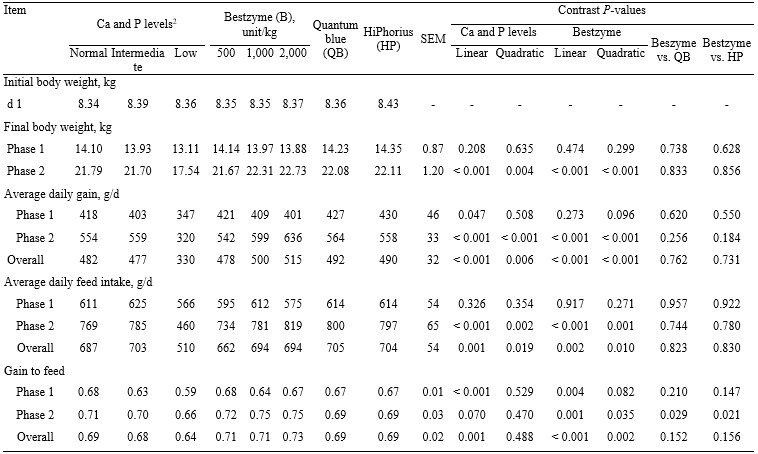
1Least mean squares represent 8 pens per treatment except for the diet containing normal Ca and P levels (n = 7).
2Diets containing normal, intermediate, and low Ca and P represent positive control, intermediate control, and negative control, respectively.
Table 2. Weight (g) and concentrations of bone ash, Ca and P (%) in pigs fed experimental diets1
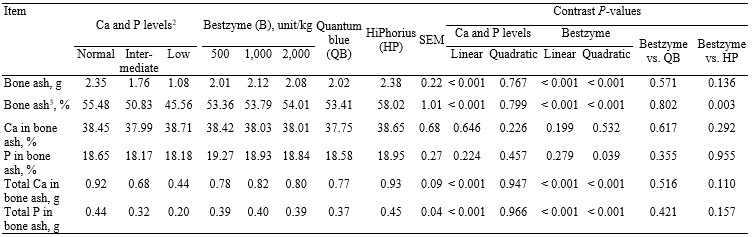
1Least mean squares represent 8 pens per treatment, with the exception for the diet containing low Ca and P levels without phytase and the diet containing 500 units/kg of Bestyzme (n = 7), and the HiPhorius and Quantum blue diet (n = 6).
2Diets containing normal, intermediate, and low Ca and P represent positive control, intermediate control, and negative control, respectively.
3Concentration of ash in defatted and dried bone samples.