Feed costs remain elevated and the environmental pressure on swine production continues to increase, which highlights the need for greater precision in diet formulation. Accurate estimation of digestible amino acids (AA) supplied by key ingredients such as soybean meal (SBM) is necessary to better match the AA requirements of pigs, improve nutrient utilization, and reduce nitrogen excretion. Microbial phytase is commonly included in diets for pigs because it hydrolyzes phytate, the primary storage form of P in oilseeds and cereal grains, thereby increasing the digestibility of P. In addition to improving P digestibility, phytase may also enhance AA digestibility in SBM-containing diets, although these responses have not been consistently observed. Recently, data from 5 experiments were summarized and it was concluded that ileal AA digestibility was improved by 3.7 to 4.5 percentage units if at least 1,000 units of phytase per kg diet was used. However, these data were based on mixed diets and responses specific to any ingredients were not reported, but because SBM is the major source of AA in diets for pigs, it is of interest to demonstrate the effectiveness of microbial phytase in the improvement of AA digestibility in SBM. Therefore, the objective of this experiment was to determine the ileal digestibility of AA in 3 sources of SBM supplemented with graded concentrations of microbial phytase. The first hypothesis was that increasing phytase inclusion would improve AA digestibility in SBM. The second hypothesis was that the response to phytase would not differ among the 3 sources of SBM.
Procedures
Three sources of SBM from different locations in the United States were labeled SBM 01, SBM 02, and SBM 03, respectively. A total of 16 growing pigs (initial body weight 25.0 ± 3.6 kg) were equipped with a T-cannula in the distal ileal and allotted to 1 of 16 diets in a Youden square design (16 pigs, 8 periods and 8 replicates for each diet). Three diets based on cornstarch and each source of SBM were formulated and no phytase was included in these diets. Each source of SBM provided all the AA in these diets. However, 12 additional diets were formulated by adding 500, 1,000, 2,000, or 4,000 phytase units/kg (Quantum Blue, AB Vista, Marlborough, UK) to each source of the initial 3 diets. A nitrogen-free diet based on corn-starch was also formulated. Diets were provided to pigs for 7 days with the initial 5 days being the adaptation period, whereas ileal digesta were collected from the cannulas of pigs for nine hours on day 6 and for 9 hours on day 7. Collected digesta were stored at -20 oC immediately after collection, and at the conclusion of the experiment, digesta were thawed, mixed within diet and pig, and a sub-sample was collected, lyophilized, and analyzed for crude protein and AA.
Results
No differences in the standardized ileal digestibility (SID) of AA among the 3 sources of SBM were observed. However, regardless of source of SBM, the SID of all AA increased (linear, P < 0.001) as the inclusion of microbial phytase in the diets increased (Table 1). The improvement in digestibility caused by 4,000 phytase units was between 4 and 5 percentage units for most AA.
Conclusions
Results indicate that source of SBM did not influence ileal digestibility of AA, whereas increasing phytase improved the SID of all AA in SBM. As a consequence, a greater value for SID of AA can be used if microbial phytase is added to diets containing SBM.
Acknowledgement
Funding for this research by The United Soybean Board is greatly appreciated.
Table 1. Standardized ileal digestibility (SID) of crude protein and amino acids in SBM diets containing graded levels of phytase and fed to growing pigs1,2,3
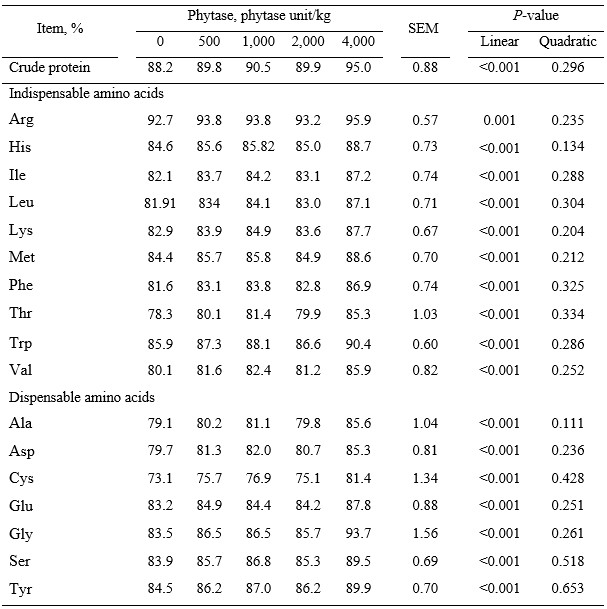
1 Interactions between source of soybean meal and level of phytase were not significant. Therefore, only the main effects of phytase are presented.
2Data represent the average of 24 observations.
3The microbial phytase was Quantum Blue (AB Vista, Marlborough, UK).