The post-weaning period is a critical period for pigs and is often associated with reduced feed intake, impaired gut health, and reduced growth performance. Pharmacological concentrations of zinc oxide have been widely used in nursery diets to alleviate these challenges, but increasing environmental and regulatory concerns have encouraged the evaluation of alternative nutritional strategies. Dietary acidifiers have been shown to reduce gastrointestinal pH, limit the proliferation of pathogenic bacteria, and support nutrient utilization in young pigs. As a result, novel acidifiers may represent a practical alternative to zinc oxide in diets for weanling pigs. Therefore, the objective of this study was to test the hypothesis that the addition of the acidifier Protacid Soy Plus (PSP; Higienizo, Madrid, Spain) to diets for weanling pigs would increase growth performance.
Materials and methods
The animal part of the experiment was conducted for six weeks. A 3-phase feeding program was used with weeks 1 and 2 as phase 1, weeks 3 to 4 as phase 2, and weeks 5 and 6 as phase 3. Four diets were formulated within phases 1 and 2 and a common diet was fed during phase 3. The control diet was a corn-soybean meal-based diet that contained 4,000 mg/kg of zinc oxide. A negative control diet that was similar to the initial diet with the exception that no zinc oxide was used in this diet was also formulated. Two additional diets were formulated by adding either 3% PSP or 1% PSP and 4,000 mg/kg of zinc oxide to the negative control diet. Inclusions of enzyme treated soybean meal were reduced as PSP was included in the diets because there were 7% in the two control diets in phase 1 and 6% in phase 2 whereas no enzyme treated soybean meal was included in diets containing 3% PSP and 3% enzyme treated soybean meal was included in the diets with 1.5% PSP.
A total of 128 newly weaned pigs [initial body weight (BW): 5.60 ± 0.27 kg] were used. There were four pigs per pen and eight replicate pens per treatment for a total of 32 pens. Fecal scores were recorded on a 5-point scale.
On the last two days of phases 1 and 2 (i.e., on day 13 and 14 and days 27 and 28), a fecal sample was collected from one pig per pen using anal stimulation. Samples were collected from the same pig on both collection days. The two samples from both days in each phase were pooled.
At the conclusion of the experiment, data were summarized to calculate average daily gain (ADG), average daily feed intake (ADFI), and average daily gain:feed ratio (G:F) for each treatment group. Likewise, data for DM and nitrogen in feces were also summarized for each treatment group. Data were analyzed using the PROC MIXED of SAS (SAS Institute Inc., Cary, NC). Normality of data was confirmed, and outliers were identified using the UNIVARIATE procedure (SAS Inst. Inc., Cary, NC). Experimental unit was the pen. The statistical mode included dietary treatment as fixed variable, and rep and rep x diet as random effects. Means were calculated using the LSMeans statement in SAS. The pdiff statement was used to separate means if the model was significant. Statistical significance and tendency were considered at P < 0.05 and 0.05 ≤ P < 0.10, respectively.
Results
In phase 1, pigs fed the PSP diet had greater (P < 0.05) G:F ratio compared with pigs fed the NC diet (Table 1). In addition, there was no difference in the BW on d 14, ADG, and ADFI of pigs fed the control diet and the PSP diet or control diet and PSP + zinc diets. In phase 2, pigs fed the control diet or the PSP + Zn diet tended to have a greater (P < 0.10) BW on d 28 compared with pigs fed the NC diet or the PSP diet. In addition, pigs fed the control diet had a greater (P < 0.05) ADFI compared with pigs fed the NC or PSP diets. In phase 3, pigs fed the PSP diet in phases 1 and 2 had a greater (P < 0.05) ADG and ADFI compared with pigs fed the PSP + zinc diet in the initial 2 phases. For the overall experiment, there were no differences in BW, ADG, ADFI, or G:F among treatments indicating that 3% PSP could replace both 4,000 mg/kg of zinc oxide and enzyme treated soybean meal without negative effects on growth performance.
On day 14, pigs fed the PSP + Zn had reduced (P < 0.05) fecal scores compared with pigs fed the NC diet (Table 2), but there was no difference in fecal score between pigs fed the control diet and pigs fed the PSP diet or the control diet and PSP + zinc diets. Feces from pigs fed the NC diet had reduced (P < 0.05) DM compared with feces of pigs fed the control diet. On day 28, there was no difference in fecal DM and nitrogen in feces from pigs fed the control diet and pigs fed the PSP diet or the control diet and the PSP + zinc diets. However, pigs fed the PSP + Zn tended to have reduced (P < 0.10) nitrogen in feces compared with pigs fed the NC diet.
Key points:
- Overall growth performance did not differ among treatments, indicating the inclusion of PSP or PSP + Zn did not affect the growth performance over the 6-week period even as enzyme treated soybean meal was reduced in diets.
- PSP + Zn reduced fecal scores on day 14 and tended to reduce fecal nitrogen, indicating potential gut-health benefits of using PSP in the diets.
Table 1. Growth performance of pigs fed experimental diets1
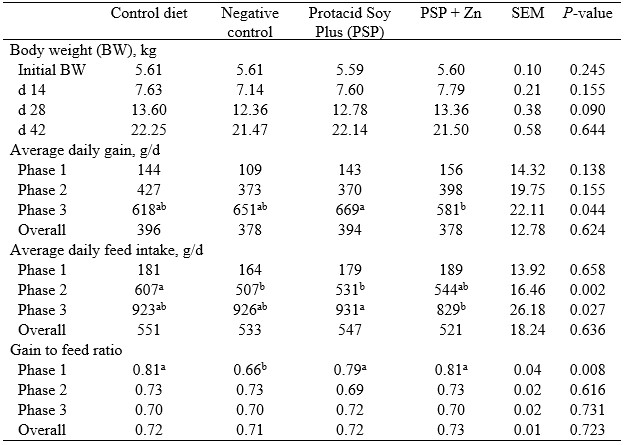
1Data are least square means of 8 observations per treatment except for the control (n = 7)
Table 2. Fecal scores and dry matter and N in feces of pigs fed experimental diets on d14 and d281
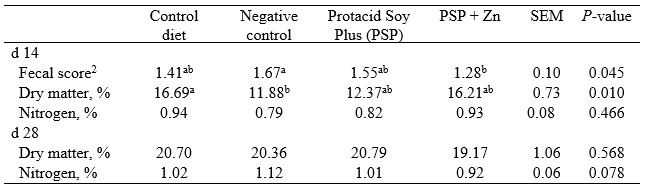
1Data are least square means of 8 observations per treatment.
2Fecal scores were visually assessed every other day from d 0 to d 14. Fecal score: 1, normal feces; 2, moist feces; 3, mild diarrhea; 4, severe diarrhea; and 5, watery diarrhea.