Canola meal and soybean meal (SBM) are the most commonly used sources of amino acids in diets for swine. However, via genetic selection, varieties of canola with greater concentrations of crude protein and reduced concentrations of fiber have been identified. Following oil extraction, the resulting high-protein canola meal (CM-HP) contains 3 to 5 % more crude protein than conventional canola meal (CM-CV). It is, therefore, expected that CM-HP contains more digestible and metabolizable energy than CM-CV when fed to sows, but this hypothesis has not been experimentally verified (Liu et al., 2016). Therefore, it was the objective of this experiment to determine the apparent total tract digestibility (ATTD) of energy and concentrations of digestible energy (DE) and metabolizable energy (ME) in high protein canola meal, conventional canola meal, and SBM when fed to gestating sows.
Experimental Design
The main ingredients used in the current experiment were yellow dent corn, CM-HP, CM-CV, and SBM. The CM-HP and the CM-CV were obtained from Corteva, Canada, and delivered to the University of Illinois, Urbana, IL, USA. Locally produced corn and SBM were sourced by the University of Illinois. A corn-based basal diet and three additional diets based on a mixture of corn and CM-HP, CM-CV, or SBM were formulated. Thus, a total of four diets were used.
Animals and Housing
Thirty-six Camborough sows (approximately day 45 of gestation) were allotted to a randomized complete block design with three blocks of 12 sows, four diets, and three replicate sows per diet in each block. Therefore, there were a total of 9 replicate sows for each diet in the three blocks. Sows were placed in individual metabolism crates that were equipped with a self-feeder, a nipple waterer, and slatted tri-bar floors to allow for the total, but separate, collection of urine and fecal materials. All diets were fed in meal form. Sows were fed at 1.5 times the energy requirement for maintenance (i.e., 100 kcal/kg × BW0.75; NRC, 2012), which was provided in a single daily meal at 0600 h. Throughout the experiment, sows had free access to water.
Sample and data collection
The initial five days were considered an adaptation period to the diet, whereas urine and fecal material were collected from the feed provided during the following five days. Urine was collected in urine buckets over a preservative of 50 mL of 6 N HCl. Fecal samples and 10% of the collected urine were stored at -20oC immediately after collection. At the conclusion of the experiment, urine samples were thawed and mixed within animal and diet, and a sub-sample was lyophilized before analysis
Results
All animals remained healthy throughout the experiment and readily consumed their assigned diets. The ATTD of dry matter and gross energy were not different between diets containing CM-HP and CM-CV, but the corn diet and the corn-SBM diet had ATTD of dry matter and gross energy that were greater (P < 0.05) than in the two canola meal diets.
The DE in CM-HP was not different from the DE in corn or CM-CV, but less (P < 0.05) than in SBM. However, ME in both canola meals was less (P < 0.05) than in corn, but the ME in CM-HP was not different from SBM, whereas the ME in CM-CV was less (P < 0.05) than in both corn and SBM.
Conclusion
These results demonstrate that genetic improvement of canola reduces fiber and enhances energy utilization compared with conventional canola meal. Nevertheless, soybean meal remains superior as an energy-contributing protein source in diets for gestating sows.
Appreciation
Funding for this research from Agrigenetics, Canada is greatly appreciated.
Table 1. Analyzed nutrient composition of feed ingredients, as-is basis
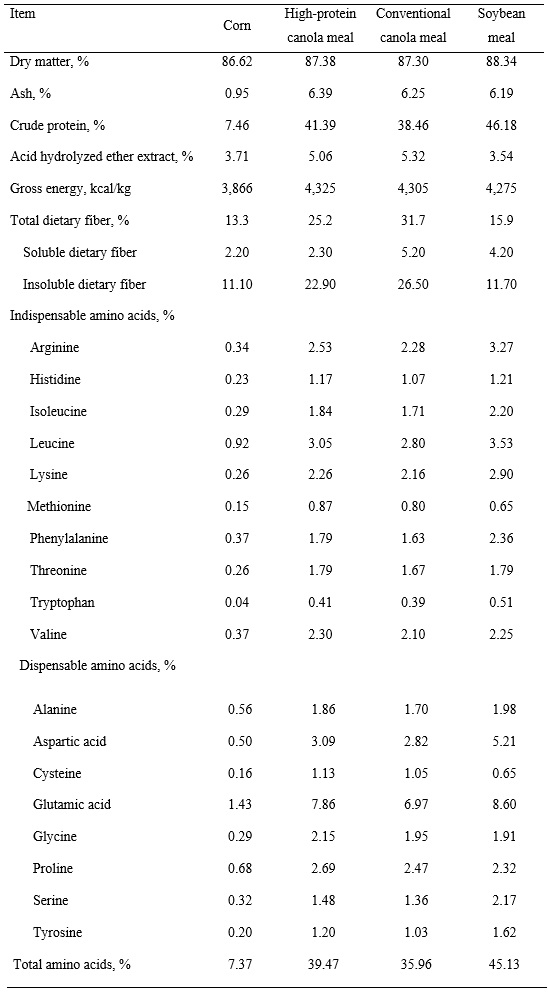
Table 2. Ingredient and analyzed composition of experimental diets containing high-protein canola meal, conventional canola meal, and soybean meal fed to gestating sows, as-is basis
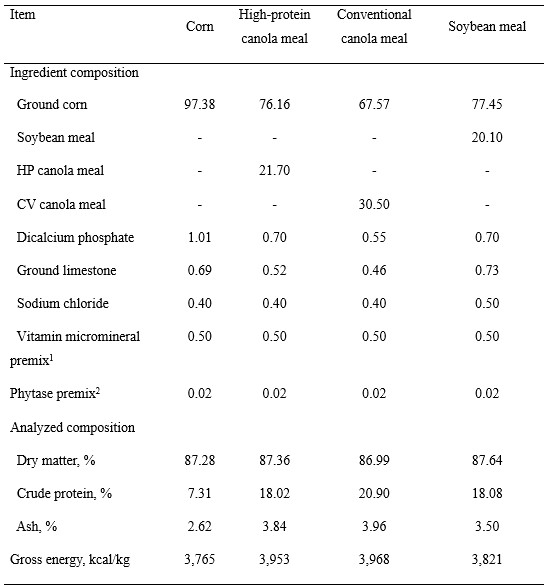
1The vitamin-micromineral premix provided the following quantities of vitamins and micro minerals per kg of complete diet: vitamin A as retinyl acetate, 10,622 IU; vitamin D3 as cholecalciferol, 1,660 IU; vitamin E as DL-alpha-tocopherol acetate, 66 IU; vitamin K as menadione nicotinamide bisulfate, 1.40 mg; thiamin as thiamine mononitrate, 1.08 mg; riboflavin, 6.49 mg; pyridoxine as pyridoxine hydrochloride, 0.98 mg; vitamin B12, 0.03 mg; D-pantothenic acid as D-calcium pantothenate, 23.2 mg; niacin, 43.4 mg; folic acid, 1.56 mg; biotin, 0.44 mg; Cu, 20 mg as copper chloride; Fe, 123 mg as iron sulfate; I, 1.24 mg as ethylenediamine dihydroiodide; Mn, 59.4 mg as manganese hydroxychloride; Se, 0.27 mg as sodium selenite and selenium yeast; and Zn, 124.7 mg as zinc hydroxychloride.
2The phytase premix was prepared by mixing corn and microbial phytase concentrate (QuantumBlue; AB Vista Feed Ingredients, Marlborough, UK; 10000 units of phytase/g). The premix was prepared by adjusting the inclusion of phytase in such a way that 0.2 % of the phytase premix provided 500 phytase units per kg of the complete diet.
Table 3. Apparent total tract digestibility (ATTD) of dry matter and energy, and concentrations of digestible energy (DE) and metabolizable energy (ME) in experimental diets fed to gestating sows as-fed basis1
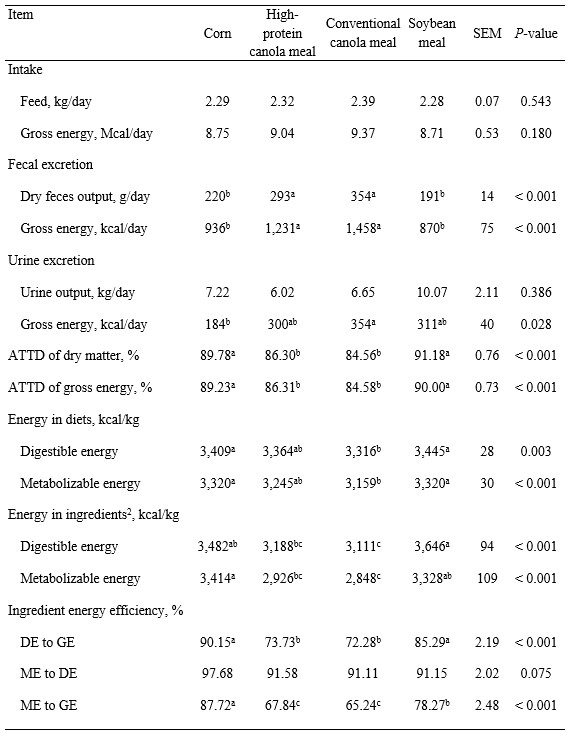
a-cWithin a row, means without a common superscript differ (P < 0.05).
1Data are least square means of nine observations for all treatments, except for corn and soybean meal diets (n = 8), and the high protein canola meal diet (n = 7).
2Concentrations of DE and ME in corn were calculated by dividing DE and ME in the corn diet by 97.38%.