When ambient temperature exceeds the thermal neutral zone, pigs experience heat stress that reduces productive performance. Alternative co-products such as canola meal and corn distillers dried grains with solubles (DDGS) contain more fiber than soybean meal (SBM), which may increase heat production in pigs and may exacerbate heat stress compared with SBM, which contains less fiber and provides bioactive components that may support immune function. Therefore, the objective of this experiment was to test the hypothesis that growing pigs fed diets containing soybean meal perform better under heat stress than pigs fed diets containing canola meal or corn DDGS.
Experimental design
Three diets contained corn and 22% SBM, 28% canola meal, or 32% corn DDGS. Ratios between digestible amino acids and metabolizable energy (ME) in all diets were equal among diets. A total of 96 pigs (initial weight: 42.1 ± 2.81 kg) were used in four blocks of 24 pigs. The 24 pigs were assigned to six calorimeter chambers with four pigs per chamber. Chambers in each block were allotted to a 2 × 3 factorial with two ambient temperatures and the three diets. Therefore, the four blocks in the experiment provided four replicates per diet.
The three treatments were assigned to chambers that had normal temperature (i.e., around 22 °C), and a relative humidity of 55%. The other three treatments were assigned to chambers that had a temperature of 32 °C during the day and 24 °C during the night. The relative humidity in these three chambers were 50% during the day and 75% during the night.
Pigs had ad libitum access to feed and water throughout the experiment. Diets were fed for 28 days in each period. After a 21-day adaptation period, O2 consumption and CO2 and CH4 productions were measured for six days to calculate total heat production. Fecal and urine samples were quantitatively collected for the six days when gases were measured, and feces and urine samples were analyzed for gross energy (GE) and nitrogen. Concentrations of digestible energy (DE), ME, and net energy (NE), and nitrogen balance in diets were calculated. Fasting heat production (FHP) of 206 kcal per kg body weight0.60 was used to calculate the daily FHP.
The statistical model included temperature, ingredient, and the interaction between temperature and ingredient as the main effects and chamber and block as random effects. The chamber was the experimental unit. Least-square means were calculated and separated if the interaction was significant using the PDIFF option with the Tukey’s adjustment.
Results
Results indicated that final body weight and average daily gain (ADG) were reduced (P < 0.05) for pigs fed the DDGS diet compared with pigs fed the SBM or canola meal diets (Table 1). Regardless of ingredient, pigs maintained under normal temperature had greater (P < 0.05) final body weight and ADG, than pigs exposed to high temperature. When pigs were kept at high temperature, average daily feed intake (ADFI) did not differ among diets, but if kept at normal temperature, pigs fed the SBM diet or the canola meal diet had greater ADFI than pigs fed the DDGS diet (interaction, P < 0.05).
Under normal temperature, retained energy did not differ between pigs fed the SBM or canola meal diets, whereas pigs fed the DDGS diet tended to retain less energy, but under high temperature, pigs fed the SBM diet tended to have greater retained energy than pigs fed the other diets (interaction, P = 0.052).
Under normal temperature, absorbed nitrogen was not different between pigs fed the SBM and canola meal diets, whereas pigs fed the DDGS diet absorbed less (P < 0.05) nitrogen than pigs fed the other diets. However, under high temperature, absorbed nitrogen was greater (P < 0.05) for pigs fed the SBM diet compared with pigs fed the canola meal diet or the DDGS diet (interaction, P = 0.008). Retained nitrogen was greater (P < 0.05) for pigs fed the SBM or canola meal diets compared with pigs fed the DDGS diet, but regardless of ingredient, more (P < 0.05) nitrogen was retained under normal temperature than under high temperature. Apparent total tract digestibility of nitrogen was greater (P < 0.05) for pigs fed the SBM diet compared with the canola meal or DDGS diets, but ATTD of nitrogen was not affected by temperature. Nitrogen retention (% of intake) was also greater (P < 0.05) for pigs fed the SBM diet than for pigs fed the other diets, but nitrogen retention (% of intake) was not affected by temperature.
In conclusion, results support the hypothesis that pigs fed the SBM diet perform better than pigs fed the DDGS diet under heat stress conditions, as indicated by greater energy retention and improved nitrogen utilization. Pigs fed the DDGS diet had the poorest performance for most parameters, whereas pigs fed the canola meal diet generally were intermediate between pigs fed the SBM and the canola meal diet.
Key points
- Growing pigs fed diets containing SBM had improved growth performance compared with pigs fed diets containing corn DDGS regardless of environmental temperature.
- Average daily feed intake, average daily gain, and daily nitrogen retention (g/day) were reduced when pigs were kept under higher temperature.
- Under heat stress, pigs fed the SBM diet retained more energy than pigs fed the canola meal or DDGS diets.
- Under heat stress, pigs fed the SBM diet absorbed more nitrogen than pigs fed canola meal or DDGS diets and nitrogen retentions determined as % of intake was greater for pigs fed the SBM diet than pigs fed the other diets.
Table 1. Growth performance, retained energy (RE), concentrations of digestible energy (DE), metabolizable energy (ME), and net energy (NE), apparent total tract digestibility (ATTD) of nitrogen (N), and nitrogen (N) balance in group-housed pigs fed experimental diets under normal or high ambient temperature.1,2
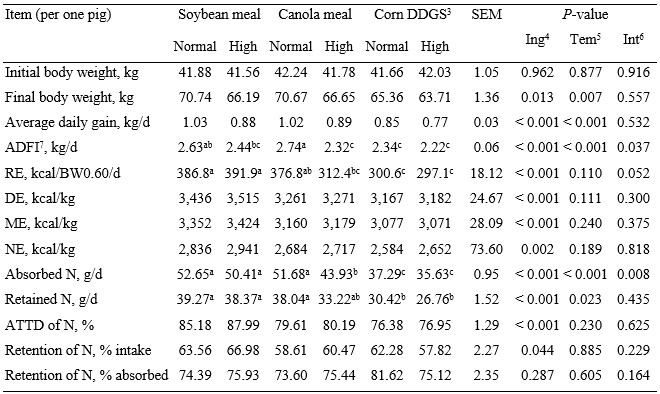
1 Temperatures (i.e., normal, 22°C and 55% relative humidity) vs. high temperature (32°C and 50% relative humidity during the day; 24°C and 75% relative humidity during the night).
2 Least mean squares represent 4 replicates per dietary treatment.
3 DDGS = distillers dried grains with solubles.
4 Ingredients; 5 Temperature; 6 Interaction; 7 Average daily feed intake.
Acknowledgement
Funding for this research by the United Soybean Board (St. Louis, MO) is greatly appreciated.