Most cereal grains and grain co-products contain very low concentrations of Ca, and the majority of Ca in commercial diets for pigs is, therefore, provided by Ca carbonate. Excess dietary Ca can reduce digestibility of P, and it is, therefore, important that digestibility of Ca in Ca carbonate is determined to allow formulation of diets based on digestible Ca.
Concentration of Ca in Ca carbonate may vary among sources depending on raw materials, geological origin, and processing methods. Differences in apparent total tract digestibility (ATTD) and standardized total tract digestibility (STTD) of Ca among sources produced in the USA have been observed, and Ca carbonate produced in Europe, Asia, and South Africa may have different STTD of Ca than Ca carbonate produced in the USA. However, no values for STTD of Ca in Ca carbonate produced in Latin America have been reported, and it is unknown if STTD of Ca differs among sources produced in different countries within this region. Therefore, the objective of this experiment was to test the hypothesis that there are differences in the STTD of Ca among sources of Ca carbonate obtained from different countries in Latin America.
Experimental design
One hundred twenty barrows (initial body weight: 16.51 ± 2.62 kg) were allotted to 4 blocks of 30 pigs using a randomized complete block design. Fifteen diets were fed to the 30 pigs in each block, with 2 replicates per diet in each block, for a total of 8 replicates per diet. Pigs were housed in individual metabolism crates equipped with a slatted floor, a nipple waterer, and a feeder.
Fourteen sources of Ca carbonate were obtained from different countries in Latin America (i.e., Brazil, Chile, Colombia, Ecuador, Mexico, and Peru). Fifteen diets were formulated based on corn and potato protein concentrate, and each source of Ca carbonate was used in one diet; a Ca-free diet was also formulated. Crystalline amino acids, vitamins, and minerals were included in all diets to meet requirements for pigs weighing 11 to 25 kg. Daily feed allowance was 3.0 times the maintenance requirement for growing pigs, provided in 2 equal meals at 0800 and 1600 h, and water was available at all times.
The experimental period lasted 11 days, with the initial 5 days being the adaptation period, followed by 4 days of collection using the marker-to-marker procedure. Fecal collection began when the first marker (indigo carmine), included in the morning meal on day 6, appeared in the feces, and ceased when the second marker (ferric oxide), added on day 10, appeared. Feces were stored at –20 °C immediately after collection.
All sources of Ca carbonate, diets, and feces were analyzed for dry matter and ash, and Ca and P were analyzed using inductively coupled plasma-optical emission spectroscopy.
The ATTD of Ca in each diet was calculated. The STTD of Ca was determined by correcting the ATTD of Ca for the basal endogenous loss of Ca from pigs fed the Ca-free diet. Digestible Ca was calculated by multiplying the concentration of Ca in each source by the STTD of Ca and dividing by 100.
Normality and homogeneity of variance were verified, and outliers were identified using Internally Studentized Residuals. Data were analyzed using PROC MIXED of SAS, with source of Ca carbonate as a fixed effect and block and diet by block as random effects. Means were separated using the PDIFF statement with Tukey's adjustment. Statistical significance was considered at P < 0.05.
Results
Concentrations of Ca in the 14 sources of Ca carbonate ranged from 33.35 to 39.68% with concentration of P less than 0.1% (Table 1).
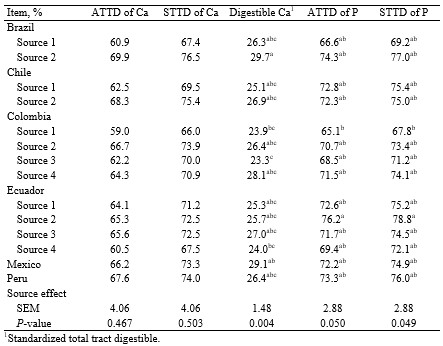
The ATTD of Ca and STTD of Ca in 14 sources of Ca carbonate from Latin America were not affected by dietary treatment (Table 2). Digestible Ca was greater (P < 0.05) in the Brazilian source 2 than in the Colombian sources 1 and 3 and Ecuador source 4, but no other differences were observed. The ATTD and STTD of P differed among diets (P < 0.05), being least for Colombia 1 and greatest for Ecuador 2.
In conclusion, 14 Ca carbonate sources contained less than the theoretical maximum of 40% Ca, with values ranging from 33.35 to 39.68% across the six countries of origin, consistent with the presence of other mineral compounds inherent to the geological origin of limestone deposits. Digestible Ca differed among sources despite the absence of differences in STTD of Ca which indicated that variation in digestible Ca was driven by differences in analyzed Ca concentration rather than differences in digestibility per se.
Key points
- All 14 Ca carbonate sources contained less than the theoretical maximum of 40% Ca.
- Digestible Ca differed among sources.
- Analyzed Ca concentration should be used in combination with STTD values to accurately estimate the contribution of digestible Ca from each source of Ca carbonate in diet formulation.
Table 1. Analyzed Ca and P in 14 sources of Ca carbonate
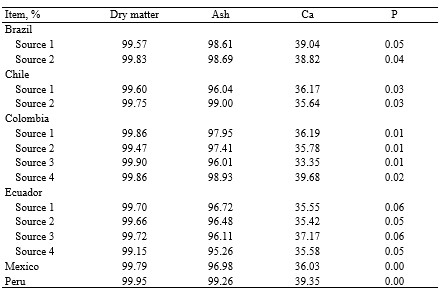
Table 2. ATTD and STTD of Ca and digestible Ca in 20 different sources of Ca carbonate