Soybean meal (SBM) is commonly used as a source of amino acids in swine diets because of its high protein content (Kudelka et al., 2021). In addition, SBM contributes with energy and phosphorus (P). However, high portion of the P in SBM is bound to phytate, which is indigestible by pigs. Therefore, microbial phytase enzyme is supplemented in swine diets. The impact of phytase on the digestibility of P is well documented, however some experiments on digestibility in corn–SBM diets has been reported energy increase if microbial phytase was used (Liao et al., 2005; Arredondo et al., 2019; Lala et al., 2020; Espinosa et al., 2022), but, not in others (She et al., 2018; Mesina et al., 2019; Lamp and Moritz, 2022). There is, however, a lack of information about the impact of microbial phytase on the digestibility of energy in SBM. It is also not known if a possible effect of microbial phytase on energy digestibility in SBM is consistent among different sources of SBM.
Therefore, an experiment was conducted to test the hypothesis that inclusion of graded levels of microbial phytase in corn-SBM diets fed to growing pigs will increase the digestibility of energy and the concentration of digestible energy (DE) and metabolizable energy (ME) in SBM. The second hypothesis was that the impact of microbial phytase on digestibility of energy in SBM is consistent among different sources of SBM.
Procedures
Three sources of SBM form different locations in the United States, were analyzed and labeled SBM 01, SBM 02 and SBM 03, respectively (Table 1). A total of 128 growing pigs (initial body weight: 14.29 ± 1.9 kg) were housed individually in metabolism crates (0.67 × 0.80 m) and assigned to a randomized complete block design, with 4 blocks, 16 diets, and 8 replicate pigs per diet. Each source of SBM was included in 5 corn-SBM diets containing 0, 500, 1,000, 2,000, or 4,000 units of phytase (FTU) per kg of diet and a corn-based diet was also used. Feces and urine were collected for 4 days after 5 days of adaptation. to determine apparent total tract digestibility (ATTD) of energy in all diets, and to calculate DE and ME in diets. The DE and ME in SBM in each of the corn-SBM diets were calculated by difference.
Results
Results demonstrated that the source of SBM had no influence on DE and ME. Phytase supplementation increased (quadratic, P < 0.01; Table 2) ATTD of dry matter (DM) and ATTD of gross energy (GE) also increased (linear, P ≤ 0.05). Consequently, DE and ME of diets increased (quadratic, P < 0.01 and P < 0.05, respectively), and DE:GE increased (linear, P < 0.05) with increasing phytase in diets. Likewise, ATTD of GE in SBM increased (linear, P < 0.01; Table 3) and DE and ME in SBM increased (quadratic, P < 0.01 and P < 0.05, respectively) as phytase inclusion increased. In conclusion, microbial phytase improves energy utilization in SBM and ME in SBM is increased by 40 to 50 kcal/kg if microbial phytase is used. The lack of difference among SBM sources indicates that the response to phytase obtained in this experiment likely can be applied to all sources of SBM.
Conclusions
The implication is that in addition to an improvement in STTD of Ca and P in SBM, microbial phytase also releases energy- containing nutrients that will result in an increase in DE and ME. Results indicate that the source of SBM does not impact the response to microbial phytase.
Appreciation
Funding for this research from United Soybean meal board, United States is greatly appreciated
Table 1. Analyzed composition of corn, and three sources of soybean meal
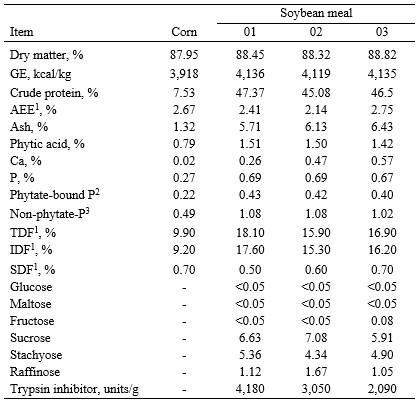
1AEE = acid-hydrolyzed ether extract; TDF = total digestible fiber; SDF = soluble digestible fiber; IDF = insoluble digestible fiber.
2Phytate-bound P was calculated by multiplying the analyzed phytic acid by 0.282 (Tran and Sauvant, 2004).
3Nonphytate-P was calculated as the difference between total P and phytate-P.
Table 2. Apparent total tract digestibility (ATTD) of dry matter (DM) and gross energy (GE) and concentrations of digestible energy (DE) and metabolizable energy (ME) of corn-soybean meal diets, containing 0, 500, 1,000, 2,000 or 4,000 units of phytase per kilogram of diet fed to growing pigs11
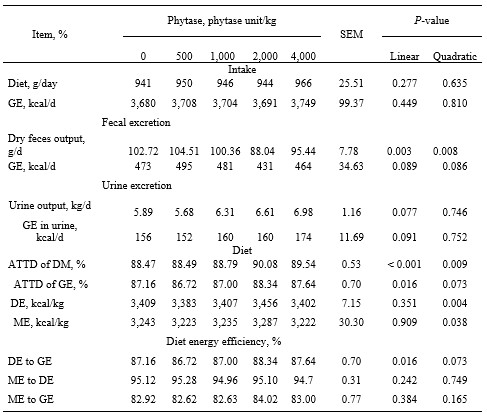
a-b Means within a row lacking a common subscript letter are different (P < 0.05). x-y Means within a row lacking a common subscript letter tend to be different (P < 0.10).
1 Interactions between source of soybean meal and level of phytase were not significant. Therefore, only main effects are presented. Data are least squares means; n = 40 for soybean meal sources and n = 24 for phytase levels.
Table 3. Apparent total tract digestibility (ATTD) of dry matter (DM) and gross energy (GE) and concentrations of digestible energy (DE) and metabolizable energy (ME) of soybean meal, containing 0, 500, 1,000, 2,000 or 4,000 units of phytase per kilogram of diet fed to growing pigs1.1
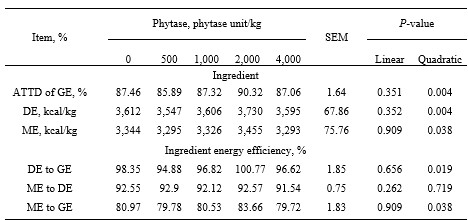
a-b Means within a row lacking a common subscript letter are different (P < 0.05). x-y Means within a row lacking a common subscript letter tend to be different (P < 0.10).
1 Interactions between source of soybean meal and level of phytase were not significant. Therefore, only main effects are presented. Data are least squares means; n = 40 for soybean meal sources and n = 24 for phytase levels.