Soybean hulls has a high concentration of dietary fiber and it is, therefore, possible that feeding SBH to lactating sows results in an improved immunity for not only the sows, but also the offspring and pigs from sows fed SBH may, therefore, have improved growth performance, digestibility of nutrients, and intestinal health. It is also possible that inclusion of SBH in diets for weanling pigs may have positive impacts on growth performance and health because small quantities of fiber have sometimes improved post weaning growth performance of pigs. However, there is limited information about the effects of SBH on growth performance and immune response of weanling pigs, and there is limited data on the performance of the offspring of sows that were previously fed SBH. Therefore, the objective of this experiment was to test the hypothesis that addition of SBH to diets for weanling pigs will improve growth performance and reduce diarrhea frequency. The second hypothesis was that pigs weaned from sows fed SBH during lactation may have improved immune system during the post-weaning period.
Animals, housing, feeding and sample collection
A total of 600 weanling pigs (initial body weight: 5.66 ± 0.87 kg) from 60 sows fed diets containing 0, 8, or 16% SBH were used in a 2 × 3 factorial with 20 pens per treatment. Ten pigs from each sow were divided into two pens of five pigs, with one pen fed a control diet without SBH and the other pen being fed a diet containing 5% SBH. Experimental diets were based on corn, soybean meal, and whey powder and formulated to meet the nutrient requirements of weanling pigs (NRC, 2012). Diets were fed in two phases, with phase one diets being fed during the initial 13 d post-weaning (5 to 7 kg) and phase two diets being fed from day 14 to 34 post-weaning (7 to 20 kg), for a total experimental period of 34 d. Pigs were housed in an environmentally controlled barn in pens equipped with a four-hole feeder, fully slatted floors, and a nipple drinker, with ad libitum access to water.
Individual pig weights and the feed left in the feeder were recorded at the beginning of the experiment, and at the end of each phase. Feces were collected on days seven and 13 from two pigs per pen via anal stimulation to determine fecal dry matter. Diarrhea scores were recorded every other day during phase 1 using a 5-point scale. On day 13 post-weaning, one pig with a body weight closest to the pen average was selected from each of 12 randomly chosen pens per treatment and a blood sample was collected from this pig to analyze for serum cytokines.
At the conclusion of the experiment, data for average daily feed intake (ADFI), average daily gain (ADG), and average gain to feed ratio (G:F) within each pen and treatment group were summarized. Data were summarized for day 1 to 13, day 14 to 34, and for the entire experiment. Data were analyzed as a 2 × 3 factorial using the MIXED procedure of SAS, with sow treatment, post-weaning dietary treatment, and their interaction as fixed effects, and block and replicate within block as random effects. However, the interaction was not significant for any parameters, and the final model, therefore, included only the main effects of sow feeding and post-weaning diets. Pen was the experimental unit for all analyses.
Results
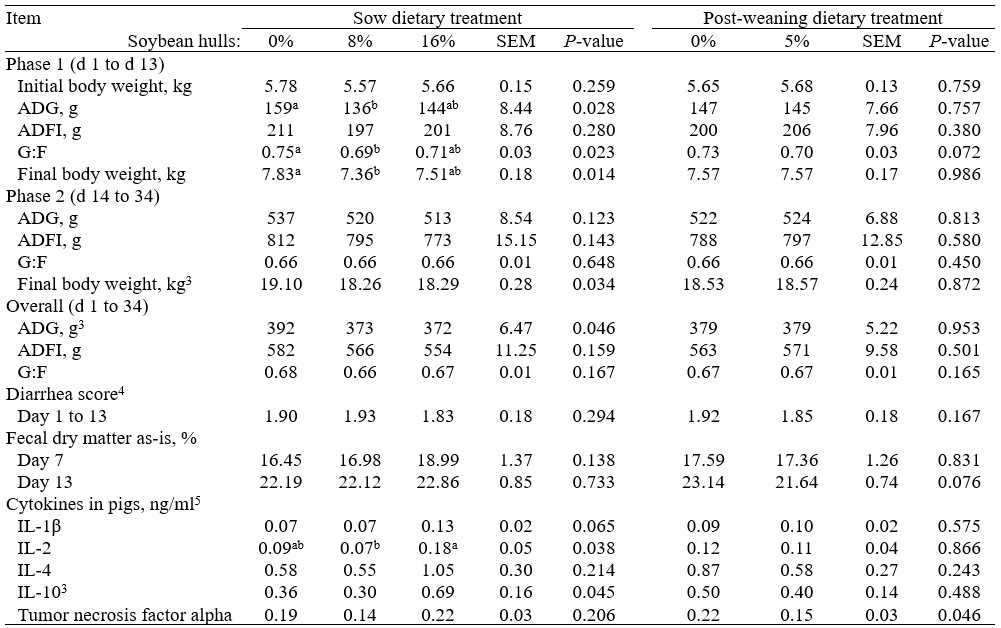
There were no effects of post weaning dietary treatments on growth performance during the overall 34-day period, but G:F in phase 1 for pigs fed the diet without SBH had a tendency to be greater (P < 0.10) compared with pigs fed the diet containing 5% SBH (Table 1). Pigs weaned from sows fed diets without SBH had greater (P < 0.05) ADG and G:F in phase 1 and greater overall ADG than pigs from sows fed 8 or 16% SBH. However, no differences in growth performance among sow dietary treatments were observed during phase 2. Final body weight was greater (P < 0.05) for pigs from sows fed diets without SBH than for pigs from sows fed 8% SBH at the end of phase 1 and 8 or 16% SBH at the end of phase 2.
Diarrhea scores and fecal dry matter were not affected by sow dietary treatment. Likewise, post-weaning dietary treatment did not affect diarrhea score or fecal dry matter on day 7, but fecal dry matter on day 13 for pigs fed the diet without SBH, had a tendency to be greater (P < 0.10) compared with pigs fed diet containing 5% SBH.
Serum cytokines IL-4 and TNF-α were not affected by sow dietary treatment. However, IL-2 of pigs from sows fed 16% SBH was greater (P < 0.05) than that of pigs from sows fed the diet with 8% SBH and IL-1β tended to be greater (P < 0.10) for pigs from sows fed 16% SBH compared with pigs from sows fed 0 or 8% SBH. TNF-α in pigs fed the diet without SBH was greater (P < 0.05) than that of pigs fed the post weaning diets with 5% SBH. However, post-weaning dietary treatment did not affect other cytokines in pigs.
Key points
- Post weaning inclusion of 5% SBH had minimal effects on growth performance of pigs.
- Inclusion of 16% SBH in sows diets during lactation may negatively affect post-weaning growth performance of offspring.
Acknowledgement:
This work was supported by a research grant from the United Soybean Board (St. Louis, MO).
Table 1. Growth performance, diarrhea score, fecal dry matter and serum response of pigs fed soybean hulls1,2,3
a−bWithin columns in the sow treatment main effect, values within a row lacking a common superscript differ (P < 0.05).
1Data are least square means of 39 observations for sow treatment containing no SBH, 38 observations for sow treatment containing 8% SBH and 36 observations for sow dietary treatment containing 16% SBH. Data are least square means of 57 observations per post-weaning treatment except for post-weaning treatment with 5% soybean hulls (n = 56).
2There was no interaction between sow treatment and post-weaning dietary treatment for any of the growth performance parameters, diarrhea score, fecal dry matter and serum response parameters. Therefore, main effects are presented.
3Although the model in which sow dietary treatment was the fixed effect was significant for the final body weight of phase two, overall ADG and IL-10, the adjusted P-value of the pairwise multiple comparison for the sow dietary treatment was not significant.
4Diarrhea scores: 1 = normal feces; 2 = moist feces; 3 = mild diarrhea; 4 = severe diarrhea; and 5 = watery diarrhea.
5Data are least square means of 23 observations per sow treatment. Data are least square means of 35 observations per post-weaning treatment except for post-weaning treatment with no inclusion of soybean hulls (n = 34).